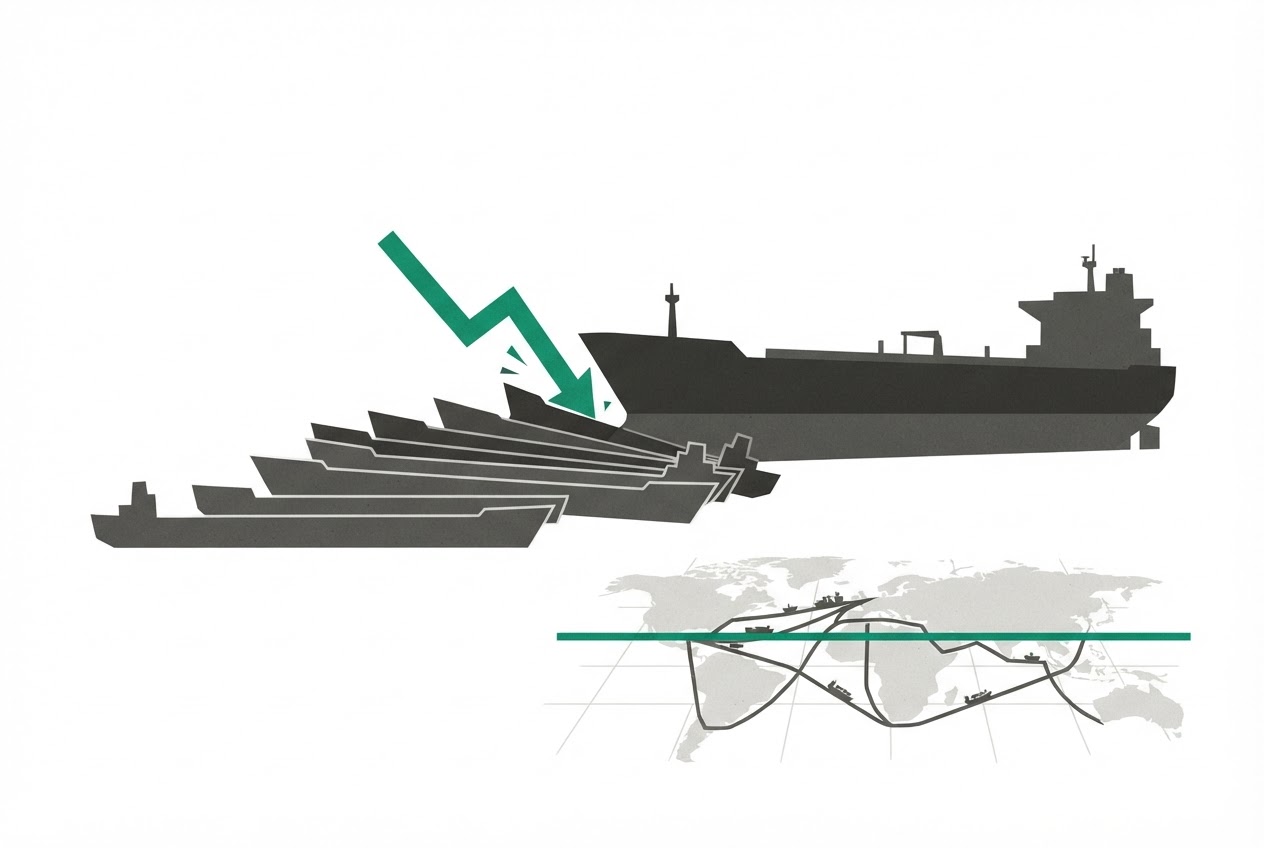
A sharp expansion in the global tanker fleet could undermine record freight earnings and elevated secondhand vessel prices, Hellenic Shipping News reported, citing S&P Global Energy CERA. Its latest outlook suggests the market will become increasingly dependent on demand growth and trading inefficiencies to absorb new ships as the supply constraints supporting recent gains weaken.
Allowing for newbuilding orders and scrapping, CERA forecasts tanker capacity rising from 703.72 million deadweight tonnes at the end of 2025 to 862.98 million in 2029, an increase of 22.6%. The order book at the end of September contained 1,494 tankers with combined capacity of 184.10 million deadweight tonnes. Very large crude carriers, or VLCCs, and Suezmaxes represented about 70.5% of that ordered capacity. Analysts identified 2028-29 as the most demanding period because deliveries of those larger vessels will be particularly heavy.
The supply outlook follows a freight rally driven by disruption after the US-Iran war began at the end of February, according to the report. Asian buyers have sought oil from more distant suppliers, while Middle Eastern producers have used ship-to-ship transfers to reduce risks associated with Strait of Hormuz transits. Platts’ Global Dirty Tanker Index for non-scrubber-fitted, non-eco vessels reached $840,921.58 a day on 2 November, more than 400% above its 27 February level. Its equivalent clean tanker index increased by more than 275% over the same period.
Those earnings have helped push operating vessels above newbuilding order prices. CERA valued a five-year-old VLCC at $185 million, a rise of 57.4% over nine months and roughly $40 million above its cited newbuilding price. Ships already trading can benefit immediately from high charter earnings. Separately, XClusiv Shipbrokers recorded 146 tanker transactions against 371 sale offers during September-October, with buying concentrated disproportionately in VLCCs and Suezmaxes.
The support from disrupted trading patterns may not last, CERA warned. More normal routes, looser sanctions or restricted ships returning to mainstream employment could expand effective supply faster than fleet growth alone suggests. Veson Nautical likewise expects vessel values to fall as deliveries build, especially among VLCCs and Suezmaxes. However, it considers a full recovery in Middle Eastern oil flows unlikely before at least mid-2027, potentially extending the disruptions that underpin near-term earnings and ship prices.